

Ford Bronco Vs. Toyota 4Runner: Which SUV Fits Your Adventure?

The Ford Bronco vs. Toyota 4Runner is a classic midsize SUV matchup, but if you're looking for a model that adapts to a vast range of escapades, the Bronco proves to be the superior choice. Wallace Ford of Kingsport invites you to discover how the Bronco stands out with its powerful performance and multifunctional configurations.
Ford Bronco vs. Toyota 4Runner at a Glance
- The 2025 Ford Bronco has two- and four-door configurations with removable doors and roof panels, while the Toyota 4Runner only offers a fixed four-door setup.
- All three of the Bronco's engine options produce more horsepower and torque than the standard gas-powered engine for the 4Runner.
- With the trail-conquering Raptor model, as well as the Sasquatch Package and up to seven G.O.A.T. Modes for all other models, the Bronco delivers terrain-tackling performance across the board; the 4Runner reserves most off-road equipment for higher trims.
- Despite a smaller exterior footprint, the Bronco provides more maximum headroom and legroom in both rows.
- The Bronco's standard 12-inch touchscreen and 12-inch digital instrument cluster outshine the smaller 8-inch infotainment and 7-inch cluster that come standard in the 4Runner.
Ford Bronco vs. Toyota 4Runner Comparison Chart
| 2025 Ford Bronco | 2025 Toyota 4Runner (Gas) | |
| Engine |
- 2.3L EcoBoost 4-cyl
- 2.7L EcoBoost V-6 - 3.0L EcoBoost V-6 |
2.4L turbo 4-cyl |
| Horsepower | 300 - 418 | 278 |
| Torque | 325 - 440 lb-ft | 317 lb-ft |
| Transmission |
- 7-speed manual
- 10-speed automatic |
8-speed automatic |
| Drivetrain | 4WD | RWD or 4WD |
| Max. Towing Capacity | 4,500 lbs1 | 6,000 lbs2 |
| Seating | 4 - 5 | 5 - 7 |
| Max. Passenger Volume | 108.2 cu ft | Not specified by OEM |
| Max. Headroom (Front / Rear) | 43.3 / 41.1 in | 39.7 / 37.8 in |
| Max. Legroom (Front / Rear) | 43.1 / 35.7 in | 41.8 / 34.8 in |
| Max. Cargo Volume | 146.5 cu ft | 90.2 cu ft |
| 2-Door Option | Yes | No |
| Removable Doors | Yes | No |
| Removable Roof | Yes | No |
| Soft Top / Hardtop Options | Yes | No |
| Standard Infotainment System | 12-in touchscreen w/ SYNC 4 | 8-in touchscreen w/ Toyota Audio Multimedia |
Ford Bronco vs. Toyota 4Runner Price, Trims & Value
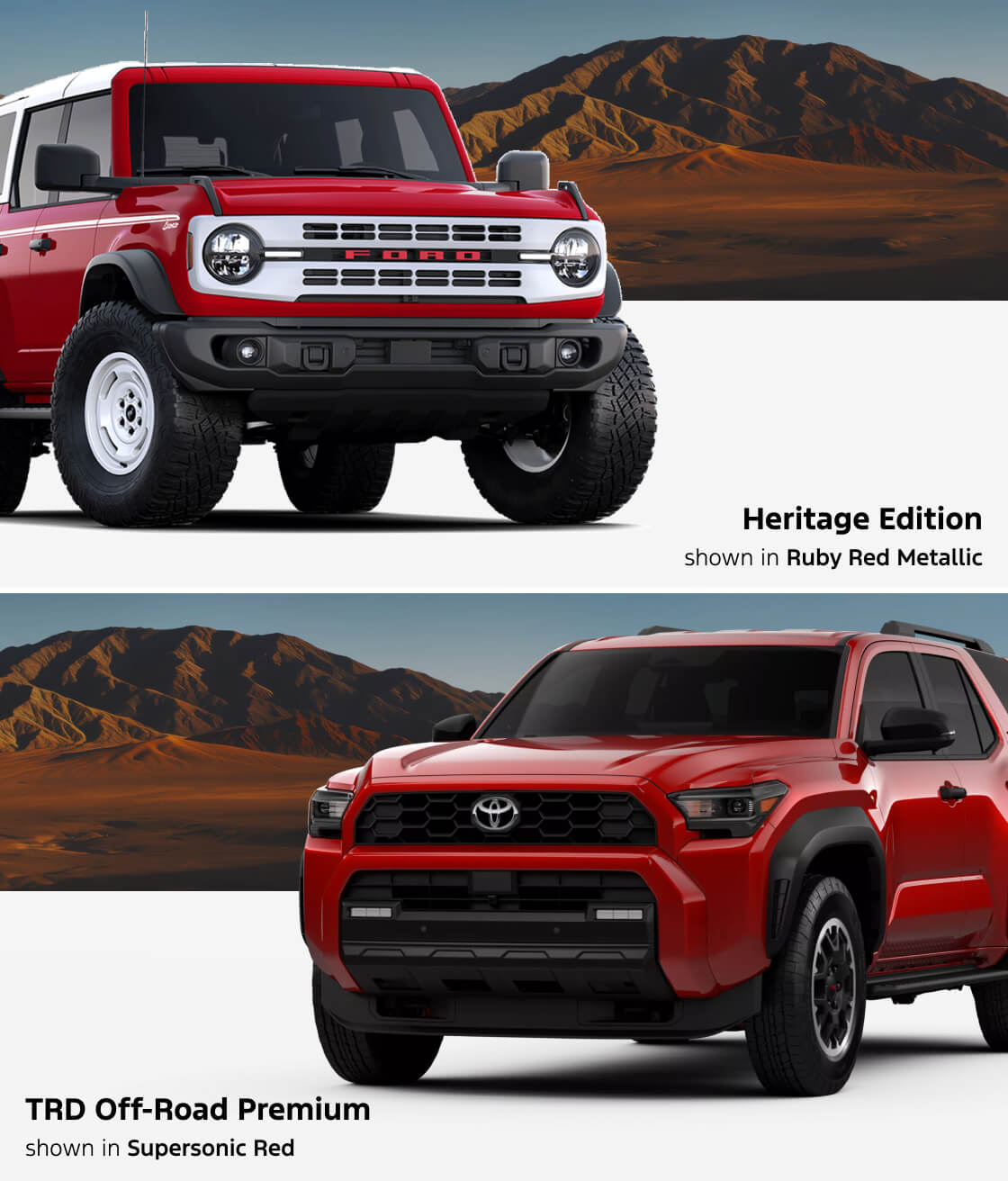
The new Ford Bronco for sale showcases seven diverse trim levels, while the 4Runner follows with six gas options.
2025 Ford Bronco trims:
- Base
- Big Bend
- Outer Banks
- Badlands
- Heritage Edition
- Stroppe Edition
- Raptor
2025 Toyota 4Runner models:
- SR5
- TRD Sport
- TRD Off-Road
- TRD Sport Premium
- TRD Off-Road Premium
- Limited
Along with a lower starting MSRP, the Bronco delivers outstanding personalization opportunities to tailor the SUV. The 4Runner, by contrast, is less customizable, a difference we'll explore in more detail below.
Ford Bronco vs. Toyota 4Runner Specs
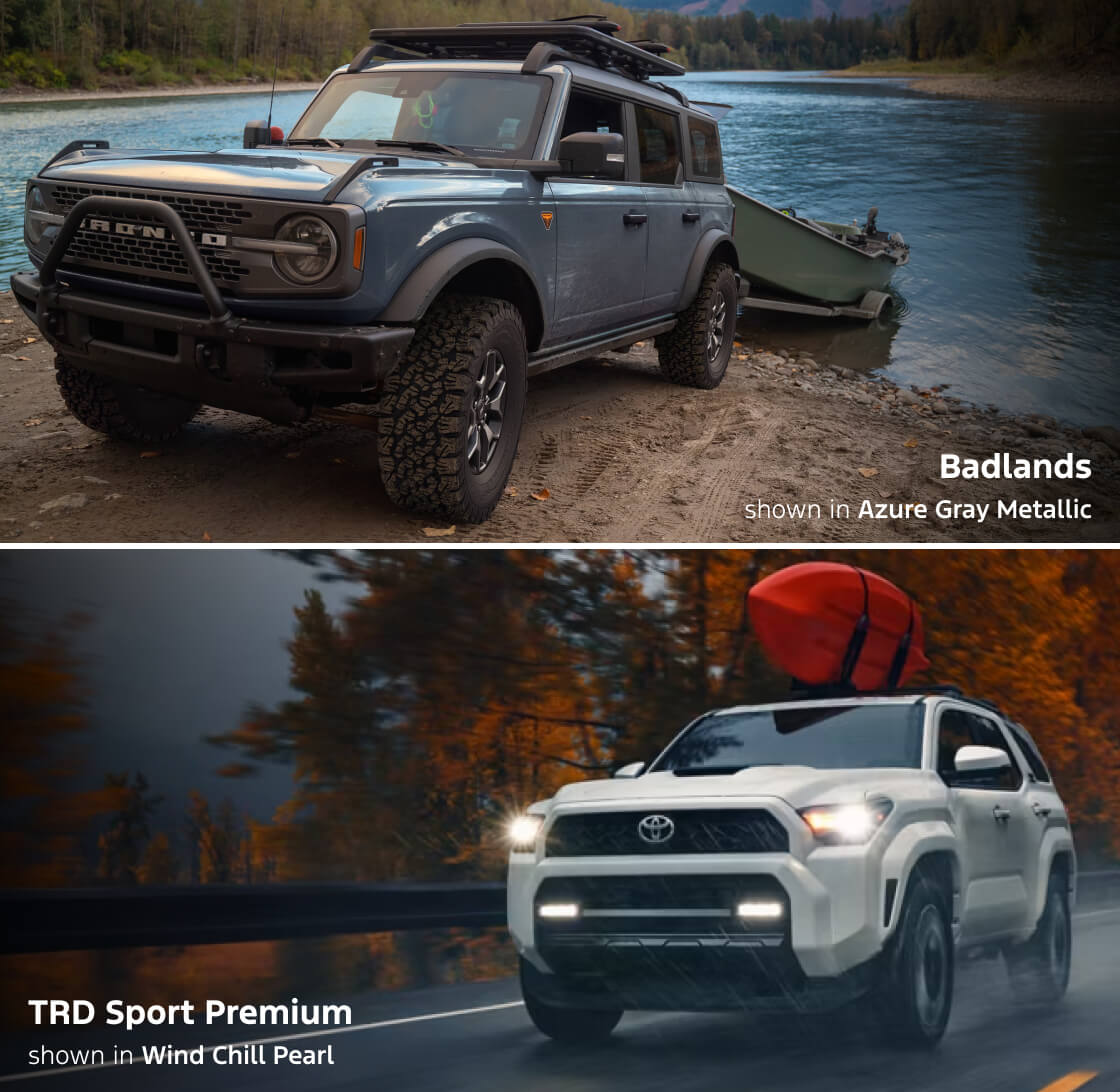
One glance, and you'll see that the 2025 Bronco breezes past its competitor in terms of engine output. All three of its powertrains outpace the gas 4Runner.
- 2.3-Liter EcoBoost Turbo 4-Cylinder: 300 horsepower and 325 pound-feet of torque
- 2.7-Liter EcoBoost Twin-Turbo V-6: 330 horsepower and 415 pound-feet of torque
- 3.0-Liter EcoBoost Twin-Turbo V-6: 418 horsepower and 440 pound-feet of torque
Meanwhile, all gas-powered 4Runners are motivated by a 2.4-liter turbocharged four-cylinder engine that produces 278 horsepower and 317 pound-feet of torque – respectable, but outmatched by every Bronco powertrain. Ford's rugged icon also offers a seven-speed manual transmission with a dedicated crawler gear for masterful low-speed control. The 4Runner only comes with an automatic, meaning it can't match the adventurous spirit and handling of the Bronco.
Ford Bronco vs. Toyota 4Runner Dimensions & Size
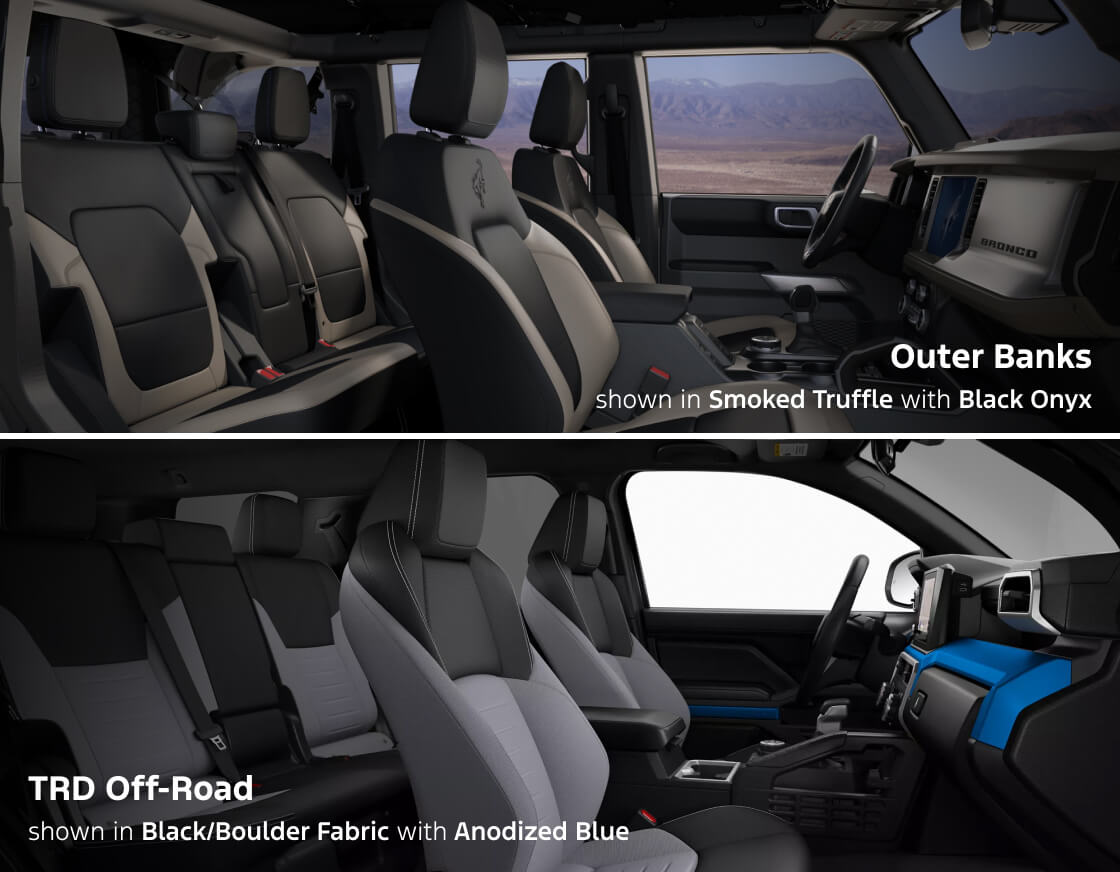
The Bronco provides seating for up to five, while the 4Runner has an optional third row that accommodates up to seven. Looking at the entry-level models (with four doors for the Bronco), the 4Runner is longer, wider, and taller. This gives the Bronco the breakover angle advantage. Plus, the Bronco provides more ground clearance and a larger wheelbase, giving a more stable, confident ride, especially while off-roading.
Versatility is also a benefit for the Ford SUV. The 4Runner sticks to tradition: a boxy, four-door build, prioritizing size over capability. On the other hand, the Bronco rewrites the rules. It boasts two- and four-door setups, all of which have removable doors and roofs. You won't get those open-air exploration opportunities with the 4Runner.
Ford Bronco vs. Toyota 4Runner Interior & Comfort
Though the 4Runner stretches longer and wider on paper, the Bronco turns those numbers inside-out with more generous cabin space. Inside, the Bronco is roomier where it counts: first-row headroom stretches to 43.3 inches, compared to the 39.7 inches in the Toyota, and rear passengers enjoy 41.1 inches versus the 37.8 inches on the 4Runner. Legroom tells the same story – up to 43.1 inches in the front and 35.7 inches in the rear for the Bronco, compared with the 41.8 and 34.8 inches in the Toyota.
Ford Bronco vs. Toyota 4Runner Tech & Infotainment
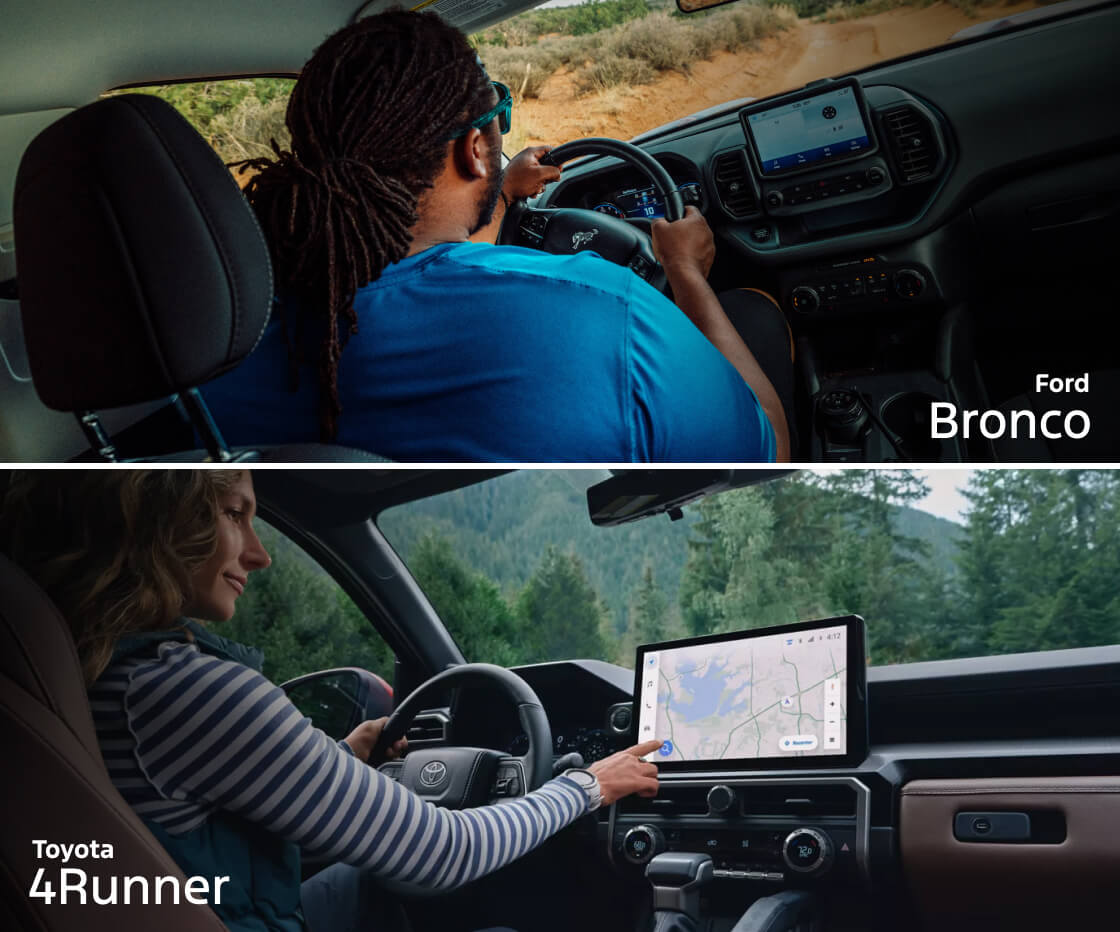
The Bronco dominates the dash with a standard 12-inch touchscreen featuring swipe capability and crystal-clear SYNC 4 voice control. The 4Runner, by contrast, has a modest 8-inch touchscreen as standard – to match the Bronco's display, you'll have to climb trims. The Bronco continues to impress with a sprawling 12-inch digital instrument cluster, almost double the size of the standard 7-inch gauge display found in the 4Runner.
Ford Bronco vs. Toyota 4Runner MPG & Safety
The 4Runner pulls ahead slightly in fuel economy, hitting up to an EPA-estimated 20/26 MPG (City/Highway)3 for gas models, whereas the Bronco earns up to an EPA-estimated 19/21 (City/Highway).4 What matters more with SUVs of this nature: a few extra miles per gallon or unrelenting power and exploration capability?
If you're seeking a Ford SUV that still packs robust performance and standard 4x4 capability with better gas mileage, explore our Ford Bronco Sport inventory. As the Bronco's smaller sibling, the Bronco Sport achieves up to an EPA-estimated 25/30 MPG (City/Highway).4
In terms of safety, both SUVs bring confidence to the road. The 4Runner comes with Toyota Safety Sense, while the Bronco secures drivers with the acclaimed Ford Co-Pilot360™ system.
Ford Bronco vs. Toyota 4Runner Features & Packages
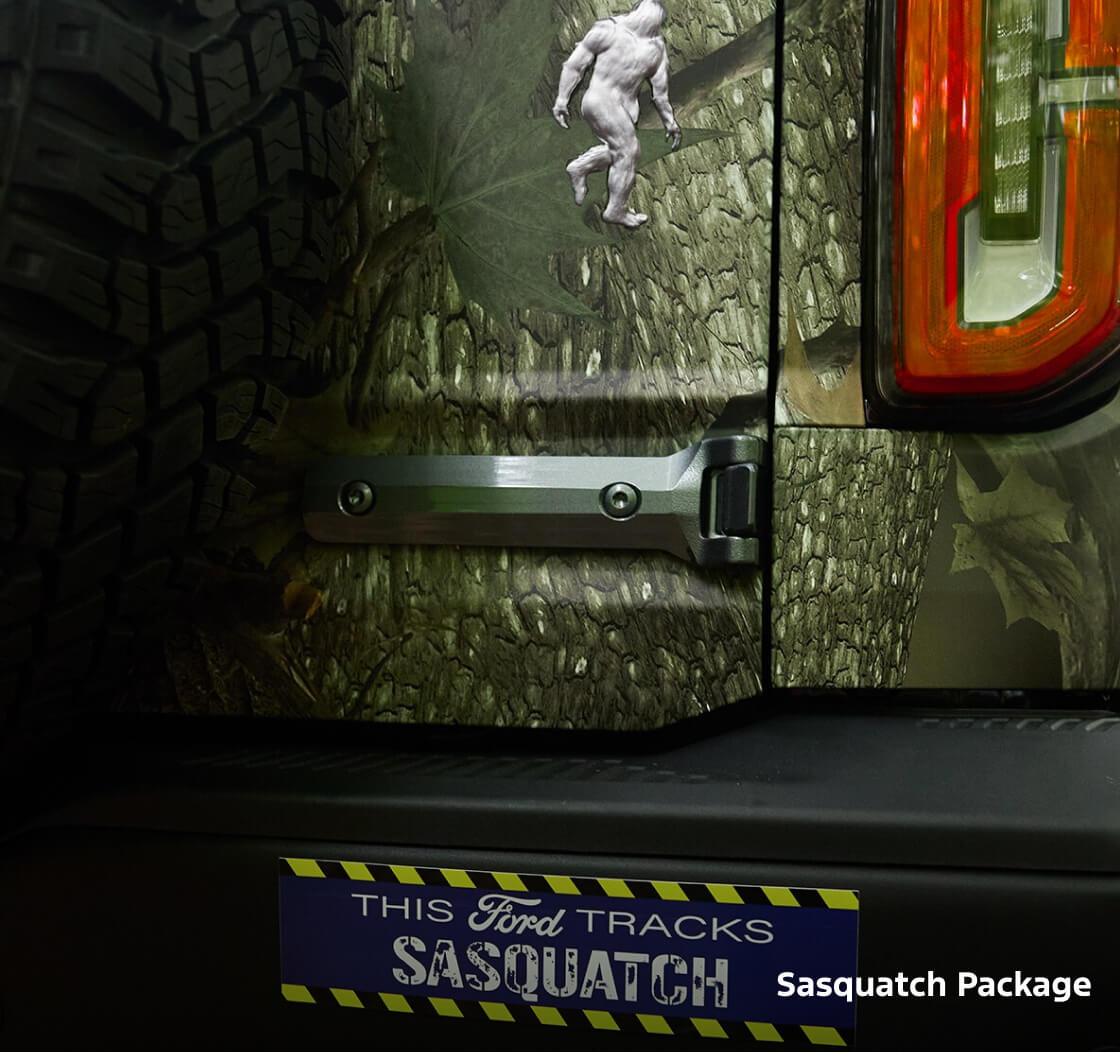
When your journey takes you off the pavement, the Bronco's Sasquatch Package is your ticket to nature-loving fun. The Sasquatch Package comes standard or is available for all models but the already-adventurous Raptor trim. It presents an arsenal of enhancements, including these:
- Advanced 4x4 with automatic on-demand engagement
- 17-inch carbonized Gray alloy wheels
- 4.7 final drive ratio paired with electronic-locking front and rear axles
- High-clearance suspension and fender flares
- Position-sensitive Bilstein® shock absorbers
Add in the Bronco's standard 4WD and up to seven signature G.O.A.T. Modes – Sand, Mud/Ruts, Rock Crawl, Baja, Slippery, Eco, and Normal – and you get a wilderness-bound vehicle. The 4Runner comes standard with RWD and locks many of its off-roading capabilities behind higher trims, meaning you have to spend more to hit the trails with confidence.
Why Settle? Take the 2025 Bronco for a Spin!
The Ford Bronco vs. Toyota 4Runner reviews are in, and the Bronco comes out on top in more ways than one. What could make this midsize SUV even better? Our new Ford Bronco deals at Wallace Ford of Kingsport.
Frequently Asked Questions
Why do the Bronco's factory off-road packages reduce the need for immediate aftermarket mods versus the 4Runner?
The Bronco's available Sasquatch Package reduces the need for aftermarket upgrades by delivering a complete off-road setup – even on the Base model. With 35-inch rugged-terrain tires, electronic-locking axles, a high-clearance suspension, and Bilstein® shocks, it's trail-ready from day one. Meanwhile, the 4Runner doesn't offer the same level of performance, even in its off-road-oriented trims.
How does the Bronco's turbocharged power delivery affect real-world performance compared to the 4Runner's engine?
The Bronco's standard turbo engine churns out 300 horsepower and 325 pound-feet of torque, offering stronger acceleration and more confident highway passing than the single turbo powertrain on the 4Runner, which produces 278 horsepower and 317 pound-feet of torque. In real-world driving, the Bronco's stronger torque output provides more responsiveness on both pavement and harsh landscapes, while the 4Runner feels more restrained.
In sand, mud, and snow, how do the Bronco's drive modes stack up against the 4Runner's traction systems?
The 4Runner provides several traditional driving modes, as well as an available Multi-Terrain Select system, giving drivers some adaptability. However, the Bronco takes adventure handling to the next level with up to seven signature G.O.A.T. Modes, including the following:
- Sand
- Mud/Ruts
- Rock Crawl
- Baja
- Slippery
- Eco
- Normal
While the 4Runner is capable, it simply doesn't match the Bronco's range of driving modes.
1When properly equipped. See dealer for details.
2Before towing, confirm your vehicle and trailer are compatible, hooked up and loaded properly and that you have any necessary additional equipment. Do not exceed any Weight Ratings and follow all instructions in your Owner's Manual. The maximum you can tow depends on base curb weight plus the total weight of any cargo, occupants, and added vehicle equipment. "Added vehicle equipment" includes additional standard/optional equipment and accessories added by the manufacturer, dealers, and/or vehicle owners. The only way to be certain of your vehicle's exact curb weight is to weigh your vehicle without passengers or cargo. [Calculated with the new SAE J2807 method.] Installation of a tow hitch receiver or other accessories located near the rear bumper or side-door kick sensors may require disabling or removing the kick sensor, and the sensor operation setting in your vehicle should be turned off. See Owner's Manual for limitations.
3Use for comparison purposes only. Your mileage will vary for many reasons, including your vehicle's condition and how/where you drive. See www.fueleconomy.gov.
4EPA-estimated city/hwy mpg for the model indicated. See fueleconomy.gov for fuel economy of other engine/transmission combinations. Actual mileage will vary. On plug-in hybrid models and electric models, fuel economy is stated in MPGe. MPGe is the EPA equivalent measure of gasoline fuel efficiency for electric mode operation.