
2026 Ford F-150 Engine Options: Specs, Power, And Towing

Ford F-150 Engine Options At a Glance
- There are six Ford F-150 engine options for 2026, including four V-6s and two V-8s.
- A best-in-class maximum towing capacity of 13,500 pounds1 proves the strength of the F-150 engines.
- A hybrid V-6 maximizes fuel efficiency, while a supercharged V-8 takes performance to the extreme.
- The "best" F-150 engine depends on your priorities!
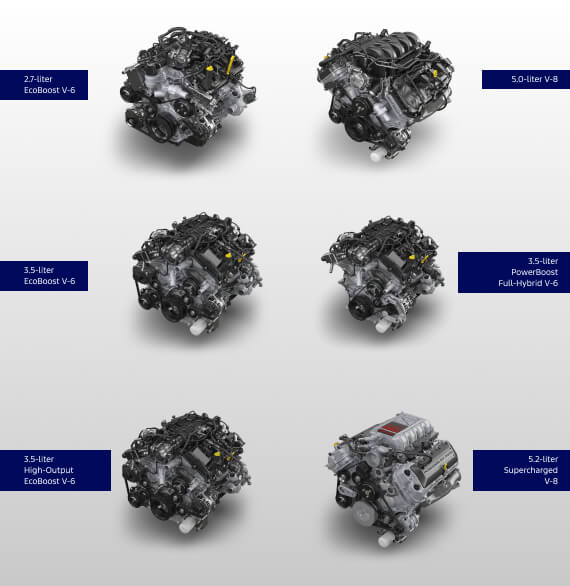
Six Ford F-150 engine options are available this year: the entry-level 2.7-liter EcoBoost V-6, the classic and capable 5.0-liter V-8, the best-in-class (for towing and payload1) 3.5-liter EcoBoost V-6, the incredibly powerful and efficient 3.5-liter PowerBoost Full-Hybrid V-6, the Raptor-exclusive 3.5-liter High-Output EcoBoost V-6, and the beyond extreme 5.2-liter Supercharged V-8. With so many options, it's only natural to want to learn more.
To do so, read this Ford F-150 engine specs guide from Wallace Ford of Kingsport and visit us to experience your favorite Ford F-150 engines from behind the wheel.
Ford F-150 Horsepower and Torque by Engine
The six Ford F-150 engines all fill their own niches, delivering different power, capability, and efficiency specs. Starting with the power outputs, the following is what you can expect from the Ford F-150 engine options:
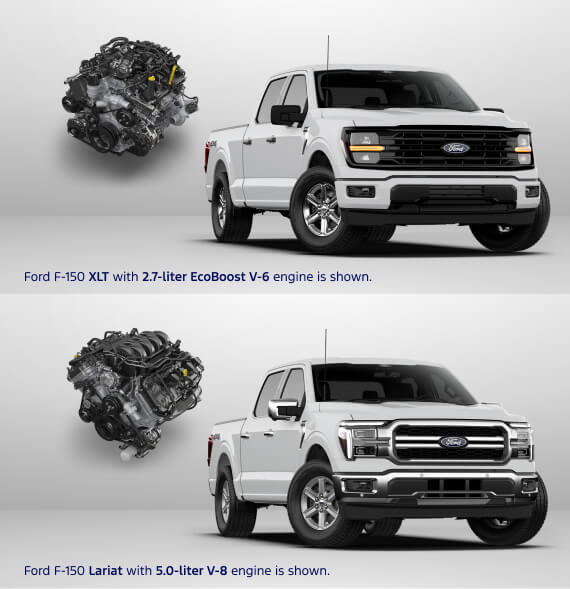
- 2.7-liter EcoBoost V-6: 325 horsepower and 400 pound-feet of torque
- 5.0-liter V-8: 400 horsepower and 410 pound-feet of torque
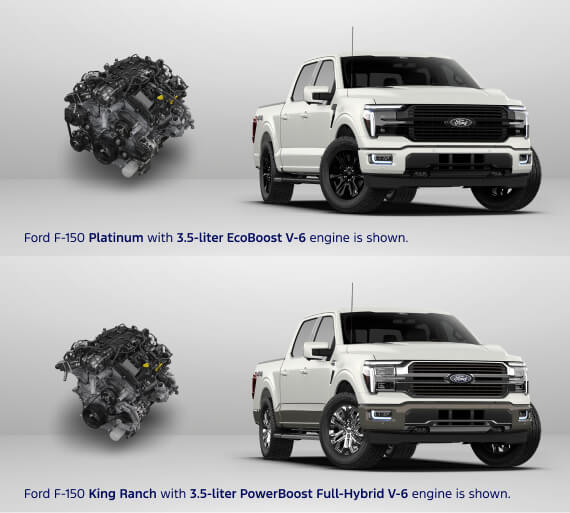
- 3.5-liter EcoBoost V-6: 400 horsepower and 500 pound-feet of torque
- 3.5-liter PowerBoost Full-Hybrid V-6: 430 horsepower and 578 pound-feet of torque
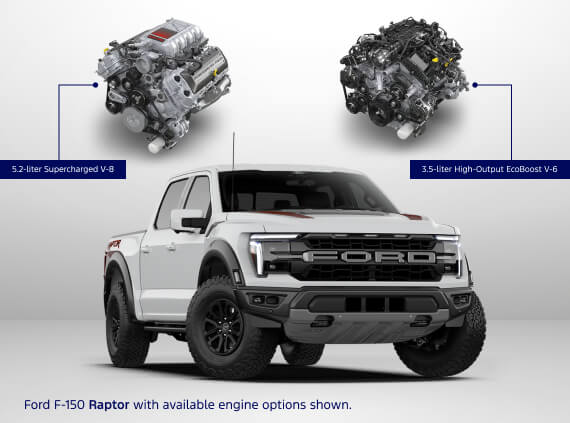
- 3.5-liter High-Output EcoBoost V-6: 450 horsepower and 510 pound-feet of torque
- 5.2-liter Supercharged V-8: 720 horsepower and 640 pound-feet of torque
While power does rise accordingly, the larger F-150 engine sizes don't necessarily result in more towing and payload capability. Here's what each engine can accomplish in that regard:
| 2.7-liter EcoBoost V-6 | 5.0-liter V-8 | 3.5-liter EcoBoost V-6 | 3.5-liter PowerBoost Full-Hybrid V-6 | 3.5-liter High-Output EcoBoost V-6 | 5.2-liter Supercharged V-8 | |
|---|---|---|---|---|---|---|
| Maximum Towing Capacity | 8,400 lbs2 | 12,800 lbs2 | 13,500 lbs2 | 11,600 lbs2 | 8,200 lbs2 | 8,700 lbs2 |
| Maximum Payload Capacity | 1,775 lbs3 | 2,235 lbs3 | 2,440 lbs3 | 1,750 lbs3 | 1,400 lbs3 | 1,400 lbs3 |
For more information about the capabilities of the Ford F-150 engine options, see our Ford F-150 towing capacity guide.
2026 Ford F-150 Engine Availability by Trim
| 2.7-liter EcoBoost V-6 | 5.0-liter V-8 | 3.5-liter EcoBoost V-6 | 3.5-liter PowerBoost Full-Hybrid V-6 | 3.5-liter High-Output EcoBoost V-6 | 5.2-liter Supercharged V-8 | |
|---|---|---|---|---|---|---|
| F-150 XL | Standard | Available | Available | N/A | N/A | N/A |
| F-150 STX | Standard | Available | N/A | Available | N/A | N/A |
| F-150 XLT | Standard | Available | Available | Available | N/A | N/A |
| F-150 Lariat | N/A | Available | Standard | Available | N/A | N/A |
| F-150 Tremor | N/A | Available | Standard | N/A | N/A | N/A |
| F-150 King Ranch | N/A | N/A | Standard | Available | N/A | N/A |
| F-150 Platinum | N/A | N/A | Standard | Available | N/A | N/A |
| F-150 Raptor | N/A | N/A | N/A | N/A | Standard | Available |
Ford F-150 Fuel Economy By Engine
2.7-liter EcoBoost V-6
Making great fuel efficiency a standard benefit, the Ford F-150 2.7 EcoBoost is only bested by the PowerBoost hybrid engine for MPG ratings. Choosing it with RWD results in an EPA-estimated 19/25 MPG (City/Highway),4 while configurations with this engine and 4WD deliver an EPA-estimated 18/23 MPG (City/Highway).4 This engine's efficiency gets even better – it only needs regular 87-octane gasoline.
5.0-liter V-8
While it's the most traditional of all the Ford F-150 engine options and is rich in performance, this V-8 benefits greatly from modern engineering and can be as efficient as a much smaller engine. And better yet, both RWD and 4WD configurations deliver the same EPA-estimated 16/24 MPG (City/Highway)4 and only need regular 87-octane gasoline, letting you maximize its capability and strength without worrying about any reductions in fuel efficiency. The main variance is that the Tremor trim with this engine delivers an EPA-estimated 16/21 MPG (City/Highway).4
3.5-liter EcoBoost V-6
The best F-150 engine for towing is also quite good for fuel-efficient commuting and road trips, further making this truck the winner of the Ford F-150 vs. Chevy Silverado 1500 debate. Specifically, it can deliver an EPA-estimated 17/25 MPG (City/Highway)4 when configured with RWD, or an EPA-estimated 17/23 MPG (City/Highway)4 if you get it with 4WD.
Meanwhile, the F-150 Tremor has an EPA-estimated 16/21 MPG (City/Highway)4 with this engine; regardless of trim or drivetrain, this EcoBoost engine only needs regular 87-octane gasoline.
3.5-liter PowerBoost Full-Hybrid V-6
It's apparent by now that the Ford F-150 PowerBoost hybrid is the most fuel-efficient F-150 engine by a significant margin: it delivers an EPA-estimated 23/25 MPG (City/Highway)4 with RWD, or an EPA-estimated 22/24 MPG (City/Highway)4 with 4WD. To help your wallet even more, the PowerBoost hybrid engine only requires regular gasoline with an octane rating of 87.
3.5-liter High-Output EcoBoost V-6
Designed for high-performance all-terrain adventure, this icon of the Ford F-150 engine options is not optimized for fuel efficiency. So, considering its fun-first engineering, the EPA-estimated 14/18 MPG (City/Highway)4 is a logical result, especially because the rest of the F-150 Raptor shares that spirit of no-compromise off-road thrills.
5.2-liter Supercharged V-8
The most extreme source of power available in the new Ford F-150 lineup, this 5.2-liter V-8 is the least fuel-efficient, but that should come as no surprise. After all, with 720 horsepower of pure gas-burning muscle at your disposal, the EPA-estimated 10/15 MPG (City/Highway)4 makes sense and is worth the fun.
How to Choose the Right F-150 Engine
The best F-150 engine is different for everyone; it all boils down to your requirements and wishes. Below are some reasons each engine may be your personal "best" choice:
- The 2.7-liter EcoBoost V-6 engine is best for: affordability and non-hybrid fuel efficiency.
- The 5.0-liter V-8 engine is best for: classic characteristics and smooth, capable power.
- The 3.5-liter EcoBoost V-6 engine is best for: no-compromise towing strength with solid performance.
- The 3.5-liter PowerBoost V-6 engine is best for: maximum fuel efficiency with adept towing/hauling capability.
- The 3.5-liter High-Output EcoBoost V-6 engine is best for: thrill-seeking adventure enthusiasts.
While it can be a tough choice, if you're local to the Kingsport area, we'd be happy to help make this decision easier. Visit us at Wallace Ford of Kingsport to try out these engines for yourself, get expert guidance about further details, and discover Ford F-150 deals that'll make these trucks even more attractive.
Frequently Asked Questions
Which engine is best in the 2026 Ford F-150?
The "best" engine in the 2026 Ford F-150 depends on your criteria. The 3.5-liter EcoBoost V-6, for example, is the best F-150 engine for towing, while the 3.5-liter PowerBoost V-6 is the best option for maximum fuel economy.
What is the difference between the F-150 2.7-liter and 3.5-liter EcoBoost?
The F-150 truck's 2.7-liter and 3.5-liter EcoBoost V-6 engines have different specs. The 2.7-liter engine has a maximum towing capacity of 8,400 pounds2 and up to an EPA-estimated 19/25 MPG (City/Highway),4 while the 3.5-liter option tows up to 13,500 pounds2 and can deliver an EPA-estimated 17/25 MPG (City/Highway).4
Does the 2026 Ford F-150 come with a hybrid engine?
The 2026 Ford F-150 can come with a hybrid engine, namely the available 3.5-liter PowerBoost Full-Hybrid V-6. This efficient star tops all other Ford F-150 engine options for fuel efficiency, delivering 430 horsepower with up to an EPA-estimated 23/25 MPG (City/Highway)4 and offering a maximum towing capacity of 11,600 pounds.2
1Maximum towing capabilities are for properly equipped vehicles with required equipment and a 150-lb. driver and passenger and vary based on cargo, vehicle configuration, accessories, option content and number of passengers. Maximum payload capabilities are for properly equipped vehicles with required equipment and vary based on vehicle configuration, accessories, and option content. Horsepower, torque, payload and towing are independent attributes and may not be achieved simultaneously. For additional information, see your Ford Dealer.
2When properly equipped. See dealer for details.
3Maximum payload capabilities are for properly equipped vehicles with required equipment and vary based on vehicle configuration, accessories, and option content. Horsepower, torque, payload and towing are independent attributes and may not be achieved simultaneously.
4EPA-estimated city/hwy mpg for the model indicated. See fueleconomy.gov for fuel economy of other engine/transmission combinations. Actual mileage will vary. On plug-in hybrid models and electric models, fuel economy is stated in MPGe. MPGe is the EPA equivalent measure of gasoline fuel efficiency for electric mode operation.